The short version
- The DHA’s Standards for Medical Advertisement Content on Social Media cover every DHA-licensed clinic and healthcare professional, on every major platform, and the influencers who promote them.
- The medical director approves any post that names or identifies the clinic before it goes live, and keeps an archive of all posts for DHA audits.
- No absolute or exaggerated claims (“the best”, “100%”, “immediate results”), no comparisons with other clinics, and no unrealistic promises.
- Mention the risks. For surgical or invasive procedures, the warning must be easy to see.
- Patient photos need written consent. Before-and-after: same person, same lens, no editing, and a note that results can vary.
- Titles exactly as on the DHA licence. “Dr.” only for physicians, dentists and recognised PhD holders.
This guide is a plain-English summary of public news reports, written by Kiasha Marketing, an independent social media agency in Dubai. We are not linked to the Dubai Health Authority, and this is not legal advice. For the official text, ask the DHA or your licensing contact.
Who the rules cover
The rules were reported by Gulf News and Khaleej Times on 1 September 2026. They apply to DHA-licensed health facilities and healthcare professionals who advertise on Instagram, Facebook, TikTok, YouTube, Snapchat, WhatsApp and LinkedIn.
They also cover influencers who promote a facility’s services, treatments or results. If you are a clinic owner, marketing manager or the person who posts, these rules are about your work.
1. Approval, moderation and records
- The medical director approves any post that names or identifies the facility, before it goes live.
- The facility is responsible for content filmed on its premises, even when an influencer films on a personal phone and posts from a personal account.
- The medical director archives all posts, so the DHA can audit them at any time.
- The medical director appoints someone to moderate the accounts, trains staff (induction and refreshers), and makes sure they know the penalties for breaking the rules.
In practice: keep a simple approval sheet for every post (what it is, who approved it, and when), and save a copy of each month’s posts with their approvals.
2. What you can and can’t say
Allowed, according to the reports: clear facts about your services or products, contact details, opening hours, approved qualifications and titles, safety and quality accreditations, and evidence-based public health information.
Everything you publish must be truthful, accurate, clear, up to date and easy to understand, and based on accepted medical practice, peer-reviewed research or recognised scientific sources. Claims about results need evidence.
Not allowed:
- Misleading people, or creating a need for a treatment they don’t have.
- Taking advantage of a patient’s lack of medical knowledge.
- Scare tactics, or unrealistic expectations about results.
- Claiming a unique or exclusive skill, or that your service is better than another provider’s.
- Negative or unfounded statements about other doctors, facilities or government bodies.
- Content against UAE culture or Islamic values, or content showing intimacy.
3. Words to avoid, and what to say instead
The reports list these absolute or exaggerated words and phrases:
uniqueone of a kindthe bestexclusivesafestthe onlyincomparableunprecedentedmagicmiraculousassured successhas no side effects100%absolutely certaindistinguishedfamouspioneerimmediate resultsmoney back
Comparisons are out too: nothing “better than”, “as safe as” or “safer than” another treatment or clinic. The reported list is not complete, so the safest habit is to avoid any absolute or superlative word.
| Instead of | Try |
|---|---|
| A team of licensed doctors in Jumeirah since 2012 (your real facts) | |
| Results vary from person to person. Your doctor will explain what to expect. | |
| Possible side effects are explained at your consultation. | |
| Results build over a course of sessions, planned by your doctor. | |
| Say what it actually does: “softens fine lines on the forehead”. | |
| Carried out by licensed practitioners, after a skin check. | |
| Describe your own treatment only. | |
| Dr. Sara Ahmed, Specialist Dermatologist (the exact licence title) |
Our advice: words like “painless”, “permanent”, “risk-free” and “no downtime” are not on the reported list, but they promise a result. Use them only if your doctor confirms them, with a qualifier. Every fact must be true for your clinic, and your doctor approves the final wording.
4. Risks and warnings
Posts must mention the risks that come with a treatment. For surgical or invasive procedures, the warning must sit in a clearly visible place: on the video or in the first lines of the caption, not hidden at the end of a long text.
5. Patient photos, videos and before-and-after
- Written consent before you use any patient’s picture, video or statement. Patients under 18 also need their parents’ consent.
- Before-and-after photos: the same person, taken with the same lens, with no editing, and a note that results can vary from person to person.
- No testimonials that compare different health professions.
Our advice: keep consent forms and patient records at the clinic. Anyone who designs your posts, including an agency, should receive only images you have already cleared for marketing.
6. Titles and the “Dr.” prefix
- Names, titles, qualifications and specialities must match the DHA licence exactly.
- “Dr.” is only for physicians, dentists and holders of a recognised PhD (attested by the UAE Ministry of Education).
- Titles reported as not allowed: “Cosmetic Specialist”, “Aesthetic Consultant”, “Cosmetologist”, “Anti-Ageing Specialist” and “Beauty Expert”.
7. Logos, accounts and filming
- No DHA or other government logo or name without written approval.
- Doctors who also practise outside the UAE keep a separate Dubai account that follows these rules. Facilities may not show patients treated in Dubai on their international accounts.
- No promotional filming or live-streaming in an operating theatre or procedure room while a patient is having surgery (minor or major) or is under general anaesthesia.
8. Influencers and content creators
Influencers are covered when they promote a facility’s services, treatments or results. Any post that identifies your clinic needs the medical director’s approval, and your clinic is responsible for what is filmed on its premises. Brief every creator on these rules, in writing, before filming.
Separately, the UAE’s advertiser permit for people who publish promotional content online was reported as mandatory from 1 February 2026. Ask any influencer for a valid permit number before you work with them, and check the current rules on the national media regulator’s website.
9. Paid ads on Instagram and Facebook
Paid ads follow the DHA rules and Meta’s own advertising standards, which change often. Points to check before every campaign:
- Ad text must not suggest you know the viewer’s health or appearance. “Struggling with acne?” is risky; “Questions about acne treatment?” is safer.
- Target ads for cosmetic procedures at people aged 18 and over.
- Before-and-after images are restricted in some ad categories. When in doubt, leave them out of ads.
- Avoid prescription-medicine brand names in ads: say “anti-wrinkle injections”, for example.
Free: the one-page DHA checklist
12 checks to run before any post goes live. Print it and keep it next to whoever posts for your clinic.
Get the checklist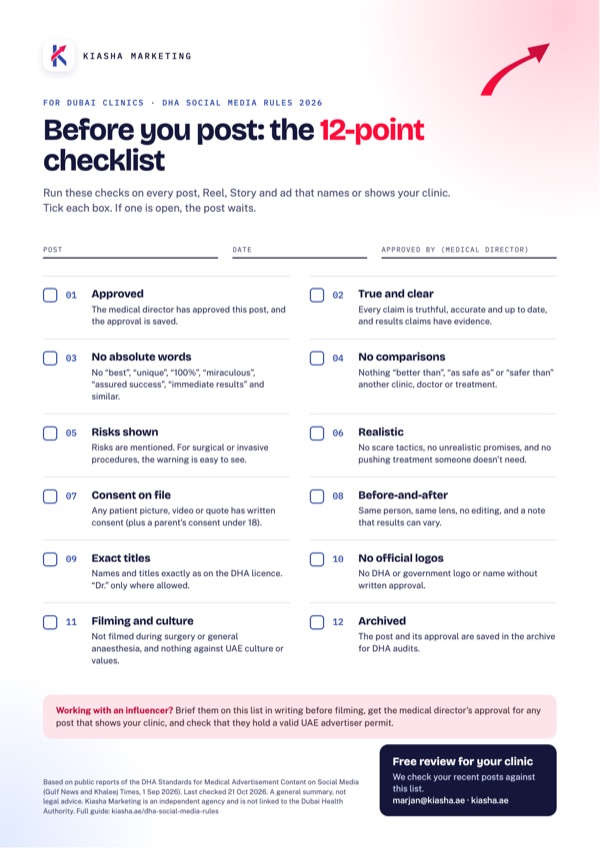
Questions clinics ask
Do the rules cover Stories, Reels and WhatsApp?
The reports list Instagram, Facebook, TikTok, YouTube, Snapchat, WhatsApp and LinkedIn. We treat every format on those platforms the same way: posts, Reels, Stories, lives and WhatsApp status.
Can we still post before-and-after photos?
Yes, with the patient’s written consent, the same person and the same lens, no editing, and a clear note that results can vary. Paid ads have extra limits from Meta.
Is the word “best” really not allowed?
“The best” is on the reported list, along with “100%”, “assured success” and “immediate results”. Describe what you actually do instead, with facts anyone can check.
Who has to approve a post?
The medical director, before it goes live, for any post that names or identifies the facility. Keep a record of each approval.
An influencer filmed in our clinic and posted on their own account. Are we responsible?
According to the reports, yes. The facility is responsible for content filmed on its premises, even when it is filmed on a personal phone and posted from a personal account.
Can we show prices and offers?
The news reports don’t mention prices. Our advice: show real prices only, never invent a deadline, and have the medical director approve price posts.
Where can we read the official text?
Ask the DHA or your licensing contact for the current standard. The DHA’s circular page was not reachable when we last checked, so this guide is based on the news reports listed below.
Sources
- Gulf News, 1 Sep 2026: Dubai issues social media rules for doctors, health facilities and influencers
- Khaleej Times, 1 Sep 2026: Words that cannot be used in doctor and clinic social media ads
- Gulf News: Advertiser permit now mandatory for influencers and creators
Last checked: 21 October 2026. Rules change. If something here is out of date, email marjan@kiasha.ae and we will correct it.